
“Easy Rider”, an ode to freedom?
On Wednesday 4 June 2025, the Cinematek – or Royal Belgian Film Archive for purists of the seventh art – screened Easy Rider, Dennis Hopper’s first film as
On Wednesday 4 June 2025, the Cinematek – or Royal Belgian Film Archive for the purists of the seventh art – screened Easy Rider, Dennis Hopper’s first film as director, in its original 1969 version. Easy Rider, often seen as a manifesto film of the American counterculture, is above all a cult film for an entire generation. Set against a legendary and timeless soundtrack[1] (Born To Be Wild by Steppenwolf as the opener, If 6 Was 9 by Jimi Hendrix, etc.), skilfully blending psychedelic rock, folk, dusty desert and green landscapes, this work embodies the prototype of the road movie, with its protagonists (Dennis Hopper / Peter Fonda) — motorised outsiders (highway cowboys who have swapped their horses for two Harley Davidsons), persecuted by the silent majority of the American South.
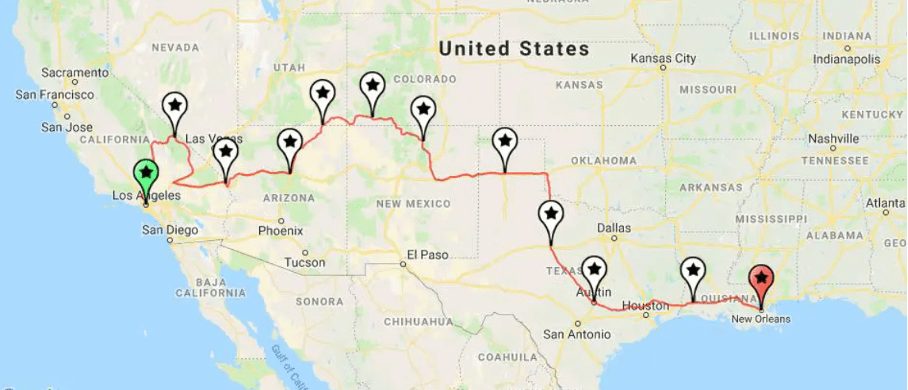
Through the journey of Wyatt (nicknamed “Captain America” because throughout the film he proudly sports a jacket emblazoned with an American flag on the back) and Billy, two bikers who cross the United States from the West (L.A.) to New Orleans (nearly 4,000 km on two wheels), the film questions the meaning of freedom in a country deeply divided between proclaimed ideals and an oppressive social reality.
- Freedom as an individual ideal
Wyatt and Billy embody the will to be free outside social norms:
The film opens in a sordid Los Angeles scrapyard in which, away from prying eyes (i.e. the LAPD), our two protagonists exchange a wad of Uncle Sam’s money for two packages containing cocaine. In passing, they also get their hands on the two motorcycles that will serve as their travelling companions throughout the journey. To cover the expenses of this long trip, the packages are exchanged again, but this time to a wealthy businessman for a far more substantial sum, on the tarmac of Los Angeles airport. This brief excerpt already lets us see the allegory of freedom. For, just like the travellers boarding planes in search of escape and a distant destination, it is also at the foot of these aluminium birds that their adventure begins.
- They reject wage labour, middle-class conformism, dress codes, social expectations.
- Their nomadic lifestyle, their drug use and their rejection of authority illustrate a hedonistic and existential freedom, close to a libertarian ideal: living without ties, without obligation, one day at a time.
At first the film seems to validate this quest: they ride across great open spaces, symbols of freedom and American immensity.
2. Confronting reality: the social limits of freedom
In Easy Rider, the road embodies an ideal of freedom without ties, an escape from social norms and a quest for authenticity. But very quickly, this quest collides with a brutal reality: 1960s American society, though enshrining freedom as a supreme value, does not tolerate those who exercise that freedom outside the established frameworks. Wyatt and Billy are rejected, harassed, then violently attacked not for what they do, but for what they represent. Their marginal appearance — long hair, leather clothes, customised motorcycles — is enough to arouse hostility in small rural towns. When they enter a restaurant in the Deep South, they are quickly targeted. The hatred they endure is not a reaction to antisocial behaviour, but to their very existence, perceived as a threat.
This rejection is stated explicitly in one of the film’s most striking lines. George Hanson, played by Jack Nicholson, sums up the situation by saying: “They’re not scared of you. They’re scared of what you represent to them. […] What you represent to them is freedom.” What society dreads is not so much the marginal individual as the possibility that he embodies a real freedom, lived outside normative control. In other words, Easy Rider points to a structural fear: that of a freedom that is not content with words, but that transforms ways of life, identities and social ties.
This tension is well described by Herbert Marcuse in One-Dimensional Man (1964), when he explains that society tolerates freedom as long as it does not call into question the foundations of the system. The counterculture is acceptable only if it is harmless, folkloric or commercial — but as soon as it becomes a serious questioning of the established order, it is rejected. Likewise, Zygmunt Bauman in Modernity and Ambivalence (1991) analyses marginal figures as threatening elements for a society obsessed with classification, order and the fixity of identities: the vagrant, the artist, the hippie are elusive figures that arouse social anxiety. The rejection of Billy and Wyatt can be read in this light: their freedom, because it is radical and untamed, provokes a need for aggressive defence among those who consider themselves “normal”.
This contrast between proclaimed freedom and lived freedom reveals a fundamental paradox: America sees itself as the land of freedom, but accepts it only in its formal form — a constitutional, abstract guarantee, integrated into the economic system. Real freedom — that is, the kind that defies norms, social roles or collective expectations — immediately becomes suspect. The film thus shows how the free individual becomes a danger: not because he acts wrongly, but because he lives differently. In this, Easy Rider illustrates an opposition between two conceptions of freedom:
Formal (legal) freedom
Real (existential) freedom
Guaranteed by laws
Practised concretely, day to day
Officially valued
Violently rejected by society
Compatible with order
Subversive of the established order
What Easy Rider shows is that true freedom is often incompatible with the social structures of control and normalisation. The work of Michel Foucault, notably in Discipline and Punish (1975), sheds light on this idea: modern societies produce implicit norms, disciplinary devices, and any deviation — even peaceful — is perceived as a threat to the balance of the social body.
In short, Easy Rider reveals that individual freedom, when it is sincere and radical, disturbs. It becomes a symbolic threat, a mirror held up to a society that believes itself free but cannot bear freedom in action. The violence endured by the two protagonists is therefore not accidental: it is the symptom of a system that tolerates difference only as long as it remains contained. Through this confrontation with reality, the film denounces the hypocrisy of an ideal of freedom that does not withstand the test of lived experience.
3. The end of the film: impossible freedom?
The conclusion of Easy Rider is of abrupt and absurd violence: as Wyatt and Billy calmly continue on their way, they are shot dead without provocation by two men in a pickup truck, simply for what they embody. This final scene does not merely close the story; it overturns it. The road, which until then seemed the space of emancipation and inner quest, becomes the very site of annihilation. Freedom, far from being attained or consolidated, ends in death — brutal, unjust, apparently devoid of meaning.
This radical ending marks a total disillusionment. The road to freedom leads nowhere; it breaks against a society incapable of accepting dissident ways of life. Easy Rider offers no victorious outcome to the libertarian adventure: it reveals, rather, its concrete impossibility in a world structured by fear, exclusion and violence. True freedom finds no place to flourish; it becomes a tragic fantasy.
Just before this dénouement, Wyatt utters a line heavy with meaning: “We blew it”. This enigmatic phrase, murmured almost into the void, resonates like an epitaph for the counterculture. Should we see in it an admission of the failure of their project of existence? A realisation that the freedom they were pursuing was only a mirage? Or an implicit critique of the libertarian utopia itself, incapable of offering anything other than a refusal of the world, but without any real alternative project?
From this perspective, the end of the film seems to express a double admission of powerlessness. On the one hand, society does not want — or cannot — welcome truly free individuals. On the other, these individuals themselves, however sincere in their quest, do not have the means to build a different world. Their journey, though imbued with symbolic grandeur, was only a flight, and their death becomes the symbol of a collective failure: that of a generation to make its ideal real.
This disillusionment could be brought closer to the thought of Theodor W. Adorno, for whom any attempt at genuine emancipation in a falsely free society is doomed to be recuperated or destroyed. In Dialectic of Enlightenment (1947), co-written with Max Horkheimer, Adorno shows that emancipation often becomes its own opposite when it finds no viable political structure. Likewise, in a more literary vein, Albert Camus, in The Rebel (1951), describes revolt as tragic as soon as it fails to build, as soon as it remains in pure negation.
Thus, Easy Rider is not simply a story of freedom flouted: it is a meditation on the impossibility of radical freedom in a world structured by the rejection of otherness. In this sense, the death of Wyatt and Billy is less an ending than a message: as long as society remains incapable of accepting the plurality of ways of life, any attempt at authentic emancipation will be doomed to marginalisation, or even erasure.
4. Philosophical analysis: being free ≠ living freely
Through Easy Rider, a major distinction emerges between freedom as discourse and freedom as lived experience. On the one hand, freedom is omnipresent in the American political narrative: it is a constitutional foundation, a cultural ideal, a central element of language in the collective imagination. On the other, as soon as it is embodied in concrete forms of life that escape the dominant norms — refusal of conventional work, rejection of dress codes, civic or spiritual disengagement — it becomes socially unacceptable.
The film makes visible what many thinkers have underlined: there is a theoretical freedom, valued by the system, and a practical freedom, lived in rupture with it. Michel Foucault, in his lectures at the Collège de France, insists on the fact that modern societies, far from being simply repressive, are above all normative: they do not always punish what is forbidden, but actively produce what is “normal”, excluding what departs from it. Thus, in Easy Rider, the freedom of the main characters is unbearable not because it is illegal, but because it is outside the norm, non-integrable, and therefore perceived as threatening.
Real freedom, when exercised in its most radical form — as complete autonomy of choice, of rhythm, of values — becomes an experience of inner exile. The free individual no longer finds a place in a world where everything is structured to frame behaviours, assign roles, and neutralise deviations. The tragedy of Easy Rider is not only the death of the characters: it is the impossibility of existing freely without provoking hatred or fear. Here we join the analyses of Isaiah Berlin, who distinguished “negative freedom” (the absence of obstacles) from “positive freedom” (the capacity for self-determination): the film illustrates acutely that even if the State does not explicitly forbid a certain way of living, society can turn it into ground for persecution.
Conclusion: Easy Rider as a tragedy of freedom
Easy Rider does not merely celebrate freedom: it reveals its tragic dimension. Throughout the film, the tension is constant between the idealism carried by the protagonists and the social reality in which they are set. America, a nation founded on freedom, makes it a cardinal value in its discourse. But this freedom seems to exist only within the limits of what society accepts, consumes or controls. Those who want to live it fully — that is, differently — become foreign bodies, rejected, sometimes eliminated.
The film thus brings to light a fundamental paradox:
Society exalts freedom as a principle, but rejects those who exercise it sincerely.
Through this contradiction, Easy Rider questions the very viability of freedom in a world that values order more than emancipation. The final question the film leaves open is deeply political and existential:
Can one really be free in a society that dreads what freedom implies?
The answer the film suggests, through its narrative and its brutal epilogue, seems deeply pessimistic. But it also invites us to rethink freedom no longer only as a formal right, but as a fragile, conflictual practice, to be reconquered endlessly and rebuilt in new social, cultural or intimate spaces.
References:
Adorno, T. W., & Horkheimer, M. (1974). La dialectique de la raison. Paris : Gallimard. (Original work published 1947)
Bauman, Z. (1991). Modernité et ambivalence. Paris : Éditions du Rouergue/Chambon.
Berlin, I. (2002). Liberté (H. Hirsch, Trans.). Paris : Presses Pocket. (Collection including “Two Concepts of Liberty”, 1958)
Camus, A. (1951). L’Homme révolté. Paris : Gallimard.
Debord, G. (1967). La société du spectacle. Paris : Buchet-Chastel.
Foucault, M. (1975). Surveiller et punir : Naissance de la prison. Paris : Gallimard.
Foucault, M. (2004). Naissance de la biopolitique. Cours au Collège de France (1978-1979). Paris : Gallimard/Seuil.
Marcuse, H. (1968). L’Homme unidimensionnel. Paris : Éditions de Minuit. (Original work published 1964)
Roszak, T. (1969). The Making of a Counter Culture: Reflections on the Technocratic Society and Its Youthful Opposition. Garden City, NY: Doubleday.
[1] The full soundtrack can be consulted directly: https://fr.wikipedia.org/wiki/Easy_Rider_(bande_originale)