
Liberalism and expression: a right in evolution
This analysis examines the relationship between liberalism and freedom of expression, underlining their importance in democracies. Although this freedom is considered fundamental,
As Mark Zuckerberg announces the return of free speech on Facebook, we propose to revisit the links between liberalism and freedom of expression. In this analysis, we will examine how these notions fit together and their implications in the current context, addressing challenges such as the rise of hate speech, disinformation, and the tensions between freedom of expression and protection against abuse.
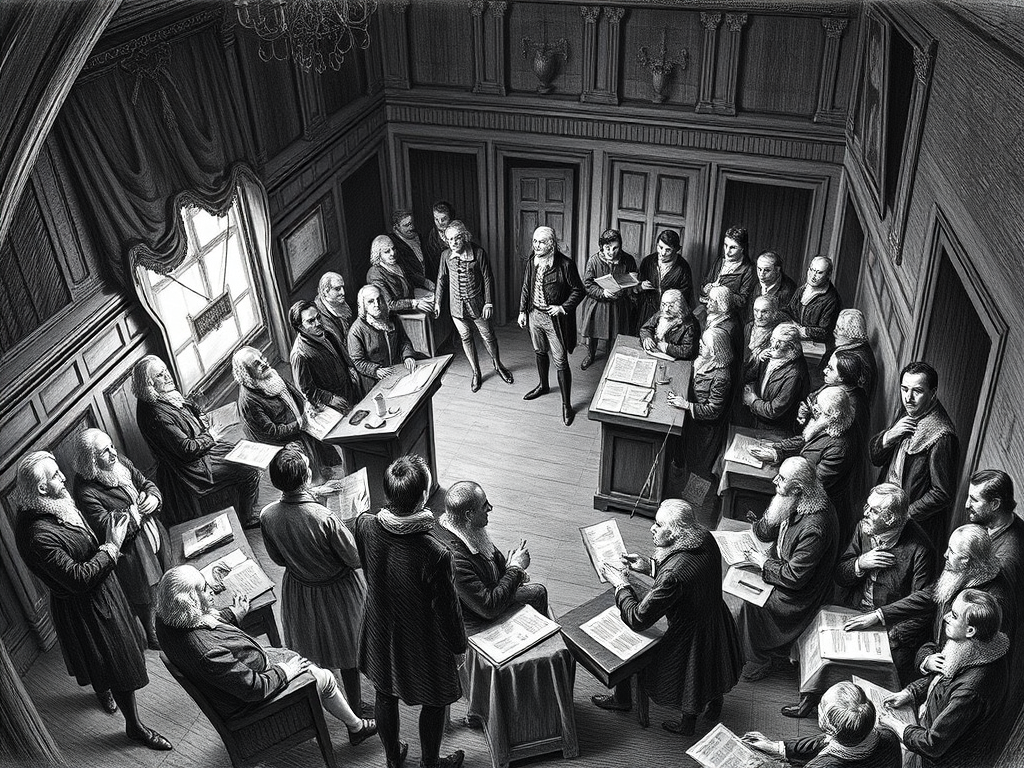
- The liberal tradition as the foundation of freedom of expression
Liberalism is a political doctrine that seeks to limit the coercive power of rulers over individuals and civil society. It values individual freedom, private property, the free market and personal autonomy. The doctrine holds that freedom of expression is fundamental to social and economic progress, enabling the open debate and criticism necessary to democracy.[1] The early classical liberal authors played a leading role through their recognition of the natural rights inherent in every individual and the effects of freedom of expression.[2]

As early as 1644, John Milton wrote that freedom of expression is an essential precondition for the pursuit of truth.[3] In his Letter Concerning Toleration, published in 1689, John Locke argued for the establishment of freedom of expression, of belief and of religious tolerance.[4]
For the philosopher, freedom of thought and expression primarily concerns the manifestation and practice of religious beliefs within the State, as well as the mutual autonomy of temporal and spiritual power. This principle underlines the autonomy of the individual within political society, guaranteeing that everyone can freely express their own convictions without outside interference, whether legal or factual.[5] This negative approach — implying a limitation of the State’s legitimate sphere of intervention to activities or expressions that could potentially harm others — is also found in John Stuart Mill. According to Mill, individuals, acting alone or together, may restrict the freedom of others only to guarantee their own security. The community can legitimately exercise force against one of its members only to prevent harm to others.[6] Progress is achieved first and foremost through the exchange of ideas and knowledge. As we can see, the advent of freedom of expression stems primarily from the investment of liberal authors.
Defining freedom of expression is no easy exercise, so much does its semantic acceptance vary across space and time. Nevertheless, history has shown us that freedom of expression is a fundamental right that holds a pre-eminent place in any democratic society, granting individuals the right to express their opinion without risking being sanctioned. It was enshrined, for the first time, in Articles 10 and 11 of the Declaration of the Rights of Man and of the Citizen of 1789. These general principles were then translated into similar forms in national constitutions and international texts.[7]
In Belgian law, from the creation of the new State, the original legislator adopted a resolutely innovative stance for the time: freedom of expression became a fundamental right recognised and protected by the 1831 Constitution, while also granting enhanced protection to freedom of opinion, of education, of the press and to the freedom of expression of those who govern, through Articles 19, 24, 25 and 58.[8] This fundamental principle is taken up in comparable forms in various international texts. Indeed, freedom of expression is enshrined respectively in Article 10 of the ECHR, in Article 11 of the Charter of Fundamental Rights of the European Union, and in Article 19 of the International Covenant on Civil and Political Rights (ICCPR). Subsequently, the legislator had to limit, progressively, freedom of expression when it infringed the rights of others. It follows that this freedom — although a fundamental right — is not absolute, and its restrictions are explicitly provided for by law.
At the supranational level, the ECHR seems to adopt an approach similar to the one described above. Its Article 10 enshrines the right to freedom of expression, which the Court has extended to the Internet. This right includes, in particular, the free expression of opinions, visions and ideas, as well as the seeking, receiving and communicating of information without frontiers. Internet users must be able to freely express their political opinions, their (non-)religious and spiritual convictions, which flows from freedom of thought, conscience and religion, enshrined in Article 9 of the ECHR. This freedom covers both favourable ideas and those that may offend or disturb. A balance must be maintained between, on the one hand, the right to freedom of expression and, on the other, the right to the protection of reputation protected by Article 8 of the ECHR concerning respect for private life. Thus, the Court reaffirmed that the rights guaranteed by Articles 8 and 10 must be protected in an equivalent manner.[9]
We can therefore observe that freedom of expression is a fundamental principle anchored in Belgian, European and international law, but that it is not absolute. Its manifestation is framed by various legislative provisions. As early as 1789, the excess of this fundamental freedom was contemplated in order, on the one hand, to protect this freedom in the face of societal upheavals and, on the other, to limit this freedom when it comes into contradiction and/or opposition with other fundamental rights or with political developments.[10] We are confronted with the difficulty the legislator faces when seeking to frame a fundamental freedom, with the same constant: to what point can a fundamental freedom be limited without breaking what constitutes its essence? Today, the development of new technologies has further complicated the reconciliation between freedom of expression and constraints of public order.
- Limiting freedom of expression for the benefit of democracy
The fundamental freedoms relating to the expression and communication of opinions are at the heart of the liberal tradition and also appear in the legislative texts of most democracies, often with reference to an earlier normative framework.[11] At the heart of this heritage, rich in definitions, liberal philosophy has forged a distinctive orientation by mobilising concepts intended to establish the intrinsic value of freedom or the advantage of the beneficial consequences it generates for individuals and society, whether personal fulfilment or collective well-being.[12]
In his work On Liberty[13], published in 1859, John Stuart Mill positioned himself in favour of a freedom of expression as unrestricted as possible. This forceful defence, though written in the 19th century, still seems relevant today. For the philosopher, the freedom to express one’s opinions is a good thing for society, because it allows truth to be reached. If restraints on freedom of expression are introduced, opinions could not be expressed, potentially harming the condition of freedom.
Freedom of expression allows, within a given society, an individual to express an opinion that departs from the one shared by the majority. Nevertheless, in general, a tension continues to persist towards those who dare to question the opinions of others (opinions the latter consider fundamental). Freedom of expression, the bedrock of any democracy, tends to favour the diversity of opinions.[14] Individuals must welcome controversy, since the pursuit of truth presupposes the confrontation of opposing claims.[15] Ultimately, for Mill, the more a society tolerates freedom of expression, the more it will flourish.
Under cover of denouncing various opinions deemed dangerous or hurtful, we are witnessing a form of censorship of freedom of expression, a smoothing-over of public discourse, a tyranny of political correctness and of right-thinking.[16] Any critical, conservative or minority speech is quickly reprimanded or denounced from all sides on the grounds that it would be offensive to this or that community (with the exception of speech inciting hatred, insults, content undermining human dignity, etc., which must be proscribed).[17] Speech that may admittedly be slightly offensive is immediately interpreted as an attack by some, who can no longer step back from the facts (emotions take precedence over human rationality). Yet, unlike hate speech, which directly attacks an individual or a group with the aim of devaluing them on the basis of an identity criterion (sex, ethnicity, age, etc.), the scope of offensive speech relates to a person or a group without seeking to denigrate them, even if it may have the effect, to varying degrees, of hurting the person or the group.[18]
The problem of freedom of expression therefore seems to arise when a disagreement between opposing opinions appears. An opinion can have two semantic meanings: it is what a person holds to be true (e.g. a religious belief, a scientific theory), but an opinion can also be a proposition that one holds to be true without possessing proof of it (there is, it turns out, an increasing tendency to reduce these false opinions).[19] We tend to depart from Mill’s position of holding that it is not possible to justify banning an opinion. For Mill, there is no less tyranny in a majority imposing its opinion on a minority consisting of a single person than in one man imposing his on a majority; above all, he seeks to denounce the tyranny of the majority in democracy. If our societies increasingly take into account the claims of certain minorities, others see their speech reprimanded because it is categorised as harmful or immoral.
Why limit the freedom of expression of “bad opinions” when they are nonetheless useful? To begin with, if an opinion is personal, for it to exist, it must be able to be expressed. Preventing someone from expressing their opinion is therefore to harm them and to prevent them from manifesting their own acts. Moreover, the benefit of the opinion does not stop with the individual who formulates it; it is also for all the others who can hear it, adhere to it or challenge it. If we systematically prevent the expression of an opinion, we hinder the ability of other people to approve and support it:[20]
- If we consider an opinion to be right or true, banning the expression of that opinion could harm all those who might have heard it, since the things it implies cannot be developed. Politically speaking, changes potentially beneficial to society are made impossible.
- If we consider an opinion to be false, we still harm the community, but to a lesser extent. The expression of a false opinion allows, after demonstration, the true opinion to be strengthened.
While certain opinions are incriminated because they would carry harmful genes, particularly in politics,[21] or while it is held that knowledge of freedom suffices and justifies censorship, Mill defends an absolute freedom of expression.[22] His argument rests on the following rule: every opinion, whatever it may be, belongs to society, and the pursuit of truth never loses from the expression of all opinions, including the most false — have our democracies reached their limits?
- [1] Huerta de Soto J. (2017), « Chapitre XXII. Principes fondamentaux du libéralisme », in J. Huerta de Soto, La théorie de l’efficience dynamique, L’ Harmattan, Paris, pp.335-342
- [2] Garessus E. (2015), « Le progrès dépend de la liberté d’expression », Le Temps (https://www.letemps.ch/economie/progres-depend-liberte-dexpression#:~:text=John%20Locke%20est%20l’une,et%20la%20libert%C3%A9%20d’expression.)
- [3] Milton J. (1644), Areopagitica, Millar, Londres, 144p.
- [4] Locke J. (1992), Lettre sur la tolérance (1689) [traduction française de Jean Le Clerc 1710], Garnier-Flammarion, 273p.
- [5] Rizk H. (2015), « Locke : la tolérance et le consentement, ou l’autolimitation du pouvoir politique », Enseignement philosophique, 65(2), p.61
- [6] Ramond D. (2013), « L’ironie de la liberté d’expression », Raisons politiques, 52(4), p.127.
- [7] Bazin F. (2015), « La liberté d’expression », Après-demain, 1(33), p.37
- [8] Behrendt C. (2019), « Liberté d’expression, une perspective de droit comparé : Belgique », Service de recherche du Parlement Européen, p.8.
- [9] Comité directeur sur les médias et la société de l’information – CDMSI (2014), « Recommandation CM/Rec(2014)6 du Comité de Ministres aux Etats membres sur un guide des droits de l’homme pour les utilisateurs d’internet – Exposé des motifs [1197e réunion] », Comité des Ministres du Conseil de l’Europe (https://search.coe.int/cm#{%22CoEObjectId%22:[%2209000016805c6fbd%22],%22sort%22:[%22CoEValidationDate%20Descending%22]})
- [10] Behrendt C. (2019), Opcit., p.10
- [11] Charest C. (1995), « Liberté d’expression et d’opinion et droits de l’homme », Documentation et bibliothèques, 41(3), p.179
- [12] Canto-Sperber M. (2016), « Liberté d’expression et quête de la vérité », Raisons politiques, 3(63), Editions Presses de Sciences Po, p.103
- [13] Mill J. S. (1859), De la liberté, Institut des Libertés – Bibliothèque Libre, Editions complétées le 19 mai 2002, Quebec, 88p.
- [14] Maler H. (2014), « Le droit à l’information, ses conditions et ses conséquences », Savoir/Agir, 4(30), p.118.
- [15] Krenc F. (2016) ; « La liberté d’expression vaut pour les propos qui ‘’heurtent, choquent ou inquiètent’’. Mais encore ? », Revue trimestrielle des droits de l’homme, 2(106), p.317
- [16] Bruckner P. (2006), La tyrannie de la pénitence, Grasset, Paris, 258 p.
- [17] Valentin P. (2021), L’idéologie Woke – Tome 2nd : Face au wokisme, Fondation pour l’innovation politique, p.26
- [18] Gauthier G. (2020), « Faut-il limiter la liberté d’expression des discours blessants ? Les affaires Slàv et Kanata », Communication, 1(106), p.121
- [19] Kaufmann L. (2003), « L’opinion publique : oxymore ou pléonasme ? », Réseaux, 1(117), pp.257-288
- [20] Sailly L. (2019), « La liberté d’expression ne doit pas se taire », Contrepoints (https://www.contrepoints.org/2019/07/01/348043-la-liberte-d-expression-ne-doit-pas-se-taire)
- [21] Verpeaux M. (2008), « Liberté expression et discours politique », Annuaire international de justice constitutionnelle, p.235
- [22] De Salle C. (2010), « La tradition de la liberté », Forum Libéral Européen ASBL, p.174