
États-Unis
What's up in America 01 — Four facts from the week of 2 November 2026
First instalment of a chronicle of American news read from Brussels. In this new column I propose to return each week to the major facts of public life that have marked the United States, read through the lens of institutional analysis. The format rests on a simple principle: each instalment will select a few facts that have marked the American media. Starting from first-hand sources, I will try, as faithfully as I can, to give an account of events and of their effects — not so much on public opinion as on the distribution of powers.
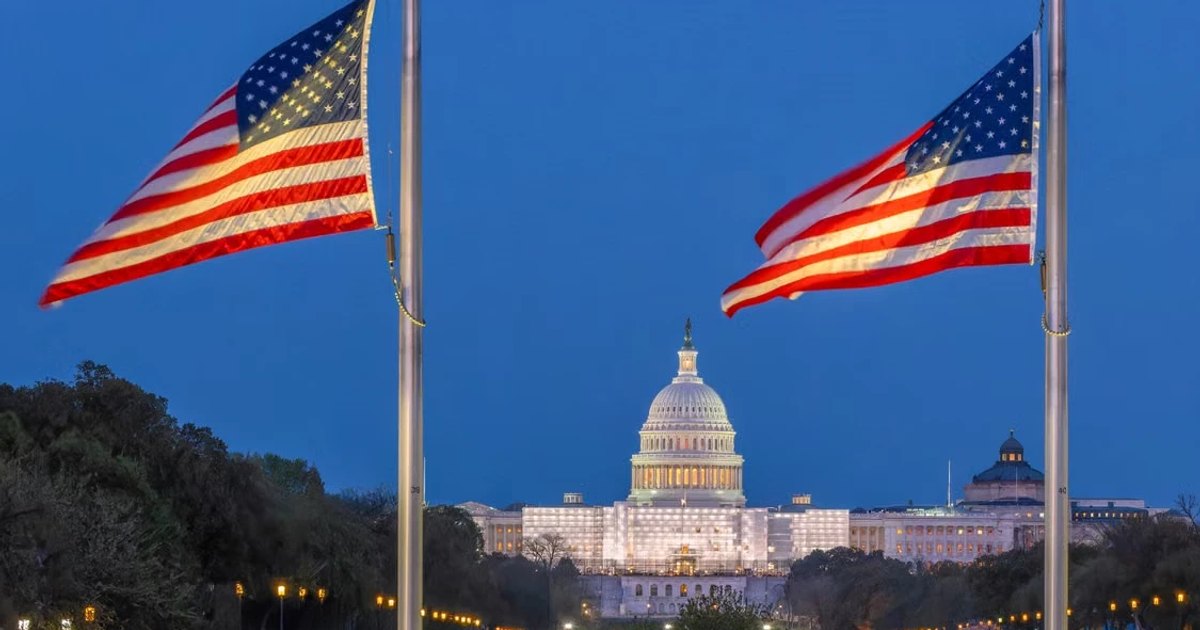
This week: the Democrats retake both chambers; artificial-intelligence stocks lose in one session what they had gained the day before; the governor of California empties death row without abolishing the death penalty; and the Supreme Court, on the eve of the election, declines to intervene. Four separate facts, one question: what institutions do when the majority changes, or when the legislature does nothing.
The voters change the rule
On 3 November 2026 the Democrats regained control of both chambers of Congress. In the Senate, CBS News projects a Democratic majority from January, with at least 54 seats secured, and records three unexpected reversals, in Texas, South Carolina and Kansas1. Two races remained open on 5 November, in Alaska and in Mississippi, where the Democrat Scott Colom led the sitting senator Cindy Hyde-Smith by fewer than two thousand votes — in a state that allows no recount and where a plurality suffices2. In the House, starting from 214 seats, the Democrats were on course for 256 according to CBS’s estimate of 5 November, with several districts still to be called3.
Two exit-poll figures convey the essentials of the climate: the president’s approval rating fell to 38%, and 89% of voters cited the cost of living as a major or decisive factor in their vote4. I shall refrain from commenting on the causes here; many analysts will already have tried their hand at it, with better arguments. I will dwell at greater length on the mechanism. In this case, it is the only fact examined this week in which the rule was changed by the holders of democratic power themselves, namely the American voters.
The market did not punish the result; it anticipated its effects
The midterm results also had a direct effect on the stock markets. On 4 November, Wall Street had one of its best days following a midterm election. On the 5th, the Nasdaq lost 5.5%, its worst session since April 2025; Nvidia and Qualcomm fell by more than 9%, the former shedding close to 450 billion dollars in market value; AMD, Micron and Applied Materials recorded double-digit losses5. The following day the Nasdaq opened higher and Nvidia recovered around 6.5%6.
What is interesting is the reason analysts gave for the fall. It was neither corporate results — Qualcomm did publish a disappointing forecast, which contributed — nor the election result as such. CNBC writes that the midterm results raised concern that the artificial-intelligence buildout was “poised to slow down”, and notes that the states with the most ambitious data-centre plans all turned Democratic7. The market therefore priced not a federal law, which does not exist, but the anticipation of a constraint exercised at state level.
One nuance deserves mention, because it complicates the story. According to the same report, forty-one local measures to restrict data centres were put to the vote in ten states; voters rejected them in every case but one8. Where they were consulted directly, voters did not want to slow the infrastructure. The market’s fear therefore concerns not the people of the counties but the governors and state legislatures they have just elected. In an earlier article, I argued that what constrains artificial-intelligence infrastructure has less to do with the European regulation than with material decisions taken elsewhere9. The session of 5 November supplies an illustration I did not expect so soon: asset prices reacted to a planning competence.
The governor exercises a power; he does not change the rule
On 5 November 2026 the governor of California, Gavin Newsom, announced the commutation of the 548 death sentences in force in the state10. Those concerned, he wrote, “will die in prison but not by our hand”. The decision continues a sequence: in 2019 he had declared a moratorium on executions and had the execution chamber at San Quentin dismantled; the state has executed no one since 200611.
It matters to say exactly what this act is and what it is not. It is not an abolition. The death penalty remains in California law, and nothing prevents a prosecutor from seeking it in a future case12. What the governor emptied is death row; the law retains its substance. The reason is known. In 2016, California voters rejected a proposition to abolish the death penalty and approved, the same day, a measure intended to speed up executions13. The governor had indicated he would support a new vote if the legislature took the initiative, which it never did.
This is therefore a pure case of what clemency permits and what it does not. It acts on persons, one by one, even five hundred and forty-eight times; it does not act on the norm. A successor may let prosecutors rebuild a death row that this one has emptied. The exercise of a power, however massive, does not have the permanence of a changed rule — and that is precisely what distinguishes this act from the vote of 3 November.
The Court declines to be an actor in the election
The fourth and final fact is without doubt the most discreet. On Monday 2 November 2026, the day before the election, the Solicitor General14 of the United States applied to the Supreme Court for emergency relief: to compel California to set aside mail ballots cast by persons the administration described as “likely noncitizens”, on the ground that more than twenty thousand of them had voted15. A federal judge in Los Angeles had refused the request on 28 October, questioning the credibility of the allegations; the Court of Appeals for the Ninth Circuit had refused it in turn on the 30th16.
The Supreme Court ruled the same day. Its order, brief and unsigned, denies the application; no dissent was noted17. No information allows its reasons to be grasped, since nothing has so far been communicated on the subject. But the form alone is enough to translate these acts into words: a Court often described as divided refused, without a single voice setting itself apart, to intervene in the counting of an election three days from its close. It let the existing rule apply, and the result occur.
In brief
In the light of these four facts, I think the reader will, as I have, have identified a thread running through and connecting these events. I would call it the question of the distribution of power. In the first, we saw that it was the voters who went to the polls who changed the rule. In the second, it was the market that bet on the power of those the election had just installed in the states — not on a law, but on the possibility of a constraint. As for the third, the governor exercised a power without changing the rule. Finally, in the last, it was the Court that declined to exercise one.
It would be convenient to see in this a system that works. I would say more cautiously that it is a system in which each actor acted within the limits of what it could do, and in which the limits held. That was not a given. It will not be one next week either.
-
CBS News, “2026 Senate midterm election results as Democrats win control”, live coverage updated 5 November 2026. In Texas, James Talarico defeated Ken Paxton. ↩
-
Ibid. Both races were rated toss-ups by CBS as of 5 November. ↩
-
CBS News, “2026 House midterm election results as Democrats capture majority”, live coverage updated 6 November 2026. The estimate of 256 seats is timed at 5:24 PM Eastern on 5 November; a range of 251 to 268 had been given the day before. These are estimates, not certified results. ↩
-
Ibid., from CBS News exit polls. ↩
-
CNBC, “AI meltdown: Nvidia and Qualcomm drop more than 9%, pushing Nasdaq to worst day since April 2025”, 5 November 2026. On the rally of 4 November, see Fortune, 5 November 2026. ↩
-
Fox Business, market report of 6 November 2026. I do not know, at the time of writing, whether the rebound holds. ↩
-
CNBC, article cited above. The same report lists, among the factors, rising interest rates and the sector’s growing capital needs. ↩
-
Ibid. The count is CNBC’s; I have not verified each of the forty-one measures. ↩
-
Nicolas Heynderickx, “What a correction would not correct: the AI bubble and European dependence”, 1 November 2026. ↩
-
CalMatters, “Gavin Newsom seeks to clear death row, commutes sentences for hundreds of prisoners”, 5 November 2026. ↩
-
Ibid. The last execution, that of Clarence Ray Allen, took place in January 2006. ↩
-
PBS NewsHour, “Newsom says he will commute all 548 of California’s death sentences to life without parole”, 5 November 2026, which specifies that the move does not repeal the death penalty and does not prevent prosecutors from seeking it in future cases. ↩
-
CalMatters, article cited above. These were Propositions 62 and 66 on the November 2016 ballot. ↩
-
Senior official of the United States Department of Justice responsible for representing the federal government before the Supreme Court. ↩
-
Amy Howe, “Supreme Court declines Trump administration’s request to intervene in California ballot dispute”, SCOTUSblog, 2 November 2026. United States v. California, No. 26A624. The application went first to Justice Kagan, as Circuit Justice for the Ninth Circuit, who referred it to the full Court. ↩
-
Ibid. Judge David Carter of the Central District of California ruled on 28 October; the Court of Appeals on 30 October. ↩
-
Ibid. The order was released to the press shortly before 6 PM on 2 November. ↩